
August 4, 2026
AI Agents: From Concept to Practice
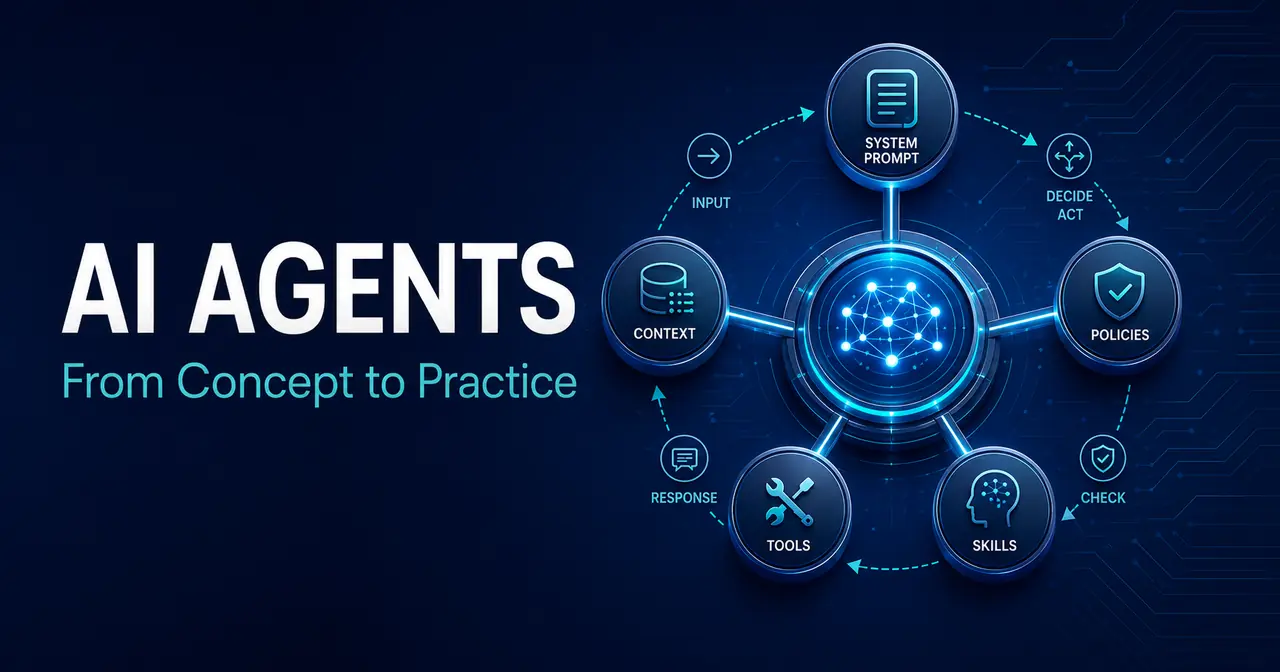
AI Agents: From Concept to Practice
AI agents are becoming an important part of modern technology. They can understand requests, make decisions, use tools and complete assigned tasks. But what exactly is an AI agent, and how does it work?
A simple real-world example makes the concept easier to understand. In an organisation, a manager sets goals and assigns responsibilities. A marketing agent focuses only on sales, while a collection agent handles payment recovery. Each person performs a specific job without becoming involved in the other person’s responsibilities.
An AI agent works similarly. It is a system built to perform a specific task using the instructions, data and tools provided to it. It operates only within its defined boundaries.
How Do AI Agents Work?
An AI agent follows a simple operational loop:
Input arrives: The agent receives a question, command or request.
Context loads: It loads relevant instructions, memory and tools.
Decide, act and check: It decides what to do, performs an action and checks the result.
Response returns: Once the task is completed, it responds in plain language.
The decide, act and check process may continue several times until the required result is achieved.
Five Building Blocks of an AI Agent
An AI agent contains five essential building blocks.
System Prompt
The system prompt is the agent’s fixed rulebook. It defines the agent’s role, responsibilities and limitations.
Context
Context is the agent’s short-term memory. It includes previous conversations and situational information such as the current date.
Policies
Policies control what the agent is permitted to do. They are checked before actions and before the final response.
Tools
Tools are individual actions the agent can perform, such as checking a calendar or sending an email.
Skills
Skills are packaged instructions for recurring tasks. They explain which tools to use, when to use them and which policies must be followed.
Practical Examples of AI Agents
Claude Code is an example of an AI agent. It reads code and previous conversations, requests approval before editing files or running commands, and extends its abilities through MCP, connected tools and prebuilt skills.
A calendar-booking assistant is another example. When a user enters, “Book 30 minutes with Priya tomorrow,” the agent checks availability, finds a suitable slot, creates the event, invites the attendee and confirms the booking.
AI Agent Frameworks
Popular AI agent frameworks include LangChain, LangGraph, CrewAI, AutoGen, Claude Agent SDK, OpenAI Agents SDK and Semantic Kernel. However, using a framework is not mandatory. Any programming language that supports HTTP requests and JSON responses can be used to build an agent.
Where Can AI Agents Be Deployed?
AI agents can run on a local machine, Platform as a Service providers such as Railway or Render, serverless platforms such as Vercel or Cloudflare, agent-native platforms such as Modal, Anthropic Managed Agents or enterprise cloud platforms such as Bedrock and Vertex.
Conclusion
An AI agent is a system designed for one clear job. It receives an input, loads context, makes decisions, uses tools, checks its work and returns a response. By combining system prompts, context, policies, tools and skills, organisations can create focused agents for practical tasks.